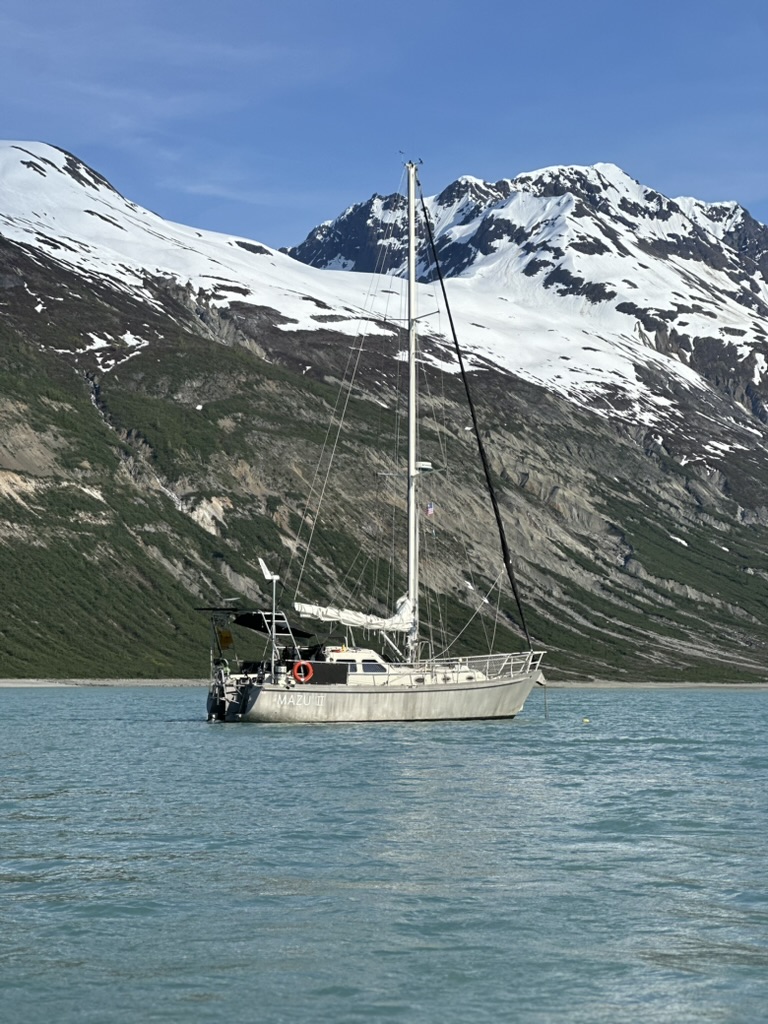
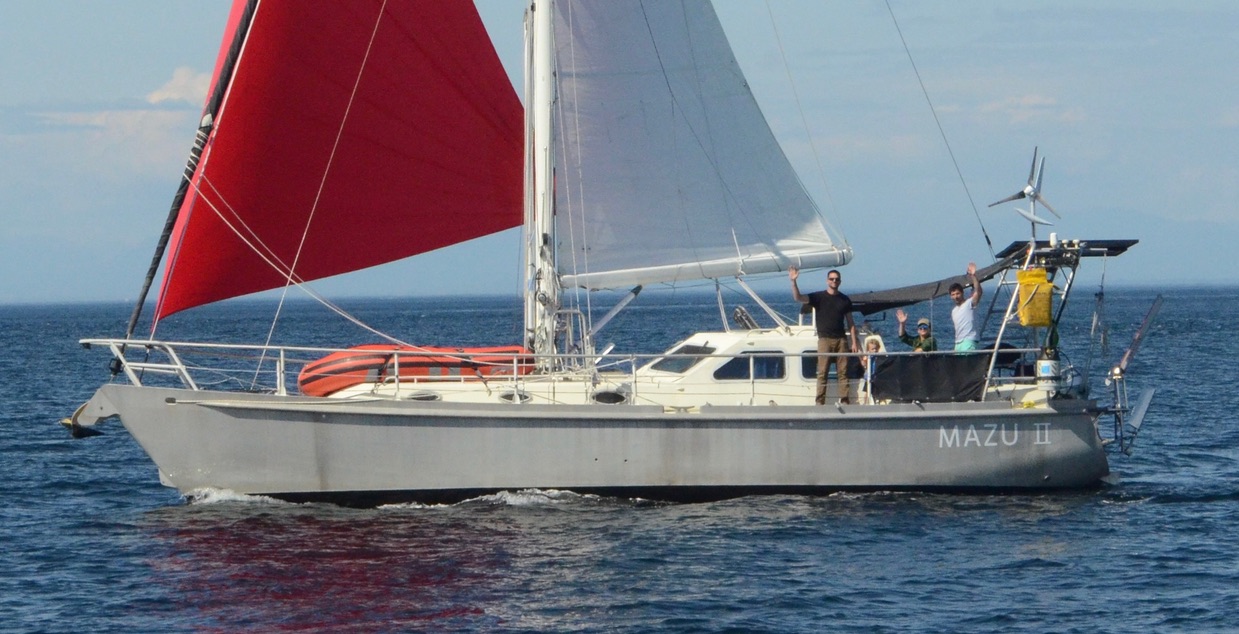
Mazu is the boat we bought to introduce our kids to high-latitude sailing and to know — really know — that they were safe. She delivered on that. One trans-Pacific passage and two Alaskan seasons later, every glacier, every pass through the Aleutians, every 40-knot williwaw night on the hook, she's earned that trust. We're selling because our family is growing faster than the interior, and a couple-plus-occasional-guests layout is getting tight for four. Here is our attempt to tell you what it's actually like to own her.
The design
She's an aluminum pilothouse boat that balances elegant lines with obvious, honest overbuild. Welded pipe lifelines. Oversized rigging. Welded-on cleats. Hull panels thicker than they need to be. She's the kind of boat people stop you on the dock about — man, that thing looks tough. The designer kept the steering brutally simple: tiller-linked, transom-hung rudder. An impact from a log or an iceberg can't flood the hull through a rudder stock, and maintenance on the whole system is close to zero. Reefing is done at the mast rather than led back to a bank of clutches in the cockpit, which keeps the working space uncluttered and the lines short. The whole boat is organized around the idea that the owner should spend time sailing, not fixing.
On deck
The pipe lifelines are tall enough to stand on without thinking about it. Side decks are wide enough to work. The cockpit is compact and self-draining, with large rear drains. The pilothouse itself is the dodger, and a watch behind the windshield on a cold Alaskan night is a genuinely pleasant place to be. Everything you need to run the boat under sail is within one reach of the helm. None of it feels fancy. All of it feels considered.
Below
The forward cabin has a queen-plus berth that a 6′5″ adult stretches out in straight. Two pilot berths at the mast make offshore-quality sea bunks. A watch bunk in the pilothouse lets the off-watch rest within arm's reach of the helm. The galley is the headline — it's huge, with a Force 10 three-burner stove on gimbals and Frigoboat top-loading refrigeration (3 cu ft fridge + 1.8 cu ft freezer) that keeps real food for real passages. The head is spacious, with a shower, and once the Autoterm 14D hydronic heater is running, it doubles as a drying room — one radiator hot enough to dry a full set of foulies overnight. Radiators also heat the forward cabin and the pilothouse. At anchor below freezing, the boat stays warm. Headroom throughout the boat is exceptional, accommodating the tallest sailors in comfort.
What she does well
She's balanced. She tracks. The oversized Yanmar has the torque to push through the current gates that define Alaskan coastal sailing; the 5′3″ shoal draft lets you tuck into anchorages that deep-keel boats pass up. The ground tackle is, in our honest words, obnoxiously oversized — 110 lb / 50 kg SARCA Excel primary, 300 feet of 3/8″ G43 chain, Maxwell HRC-10 windlass — and you sleep. The sail wardrobe is a full Port Townsend suit including light-air sails (drifter and spinnaker), all in fantastic condition, with the original mainsail and furling headsail kept as good-condition spares. Tankage is 126 gal of diesel (.65 gal/hr burn means an easy 1,250 nm motoring range before considering hauling extra cans), 150 gal of water, and a Cruise RO SM30 watermaker adds 30 gal per hour. Storage is huge — months of provisions fit under the forward bunk alone. On her six-week New Zealand-to-Hawaii delivery passage she arrived with enough stores to carry on the next three weeks to Portland without reprovisioning.
What she's been through
We took Mazu from Hawaii to Portland, around Vancouver Island, back to Portland for a shakedown refit, and then north — Gulf of Alaska, the inside passage, the glaciers of Prince William Sound, and down the Aleutians. She's currently in Cordova. A second, larger refit in 2022–2023 prepared her for serious high-latitude work: a full electrical rewire with system-wide isolation, Victron lithium house bank with AGM emergency and helm-start backup, Cerbo GX monitoring, Wakespeed external regulator, Charles isolation transformer, Dolphin leakage monitor, Autoterm 14D hydronic heating, a new navigation suite (2× Raymarine Axiom Plus 7 chartplotters, Evolution autopilot, Icom IC-M424G VHF), and a new Crewsaver liferaft, ACR EPIRB and PLBs. The inventory page lists every part; what a list can't show is that we've used all of it, and it works.
Who she's for
If you want a boat to take your partner and your kids or your friends into cold water safely, this is that boat. We had plans to sail her to the end of the Aleutians — and she's ready for exactly that tomorrow. She's for the couple, or the small cruising crew, that wants a vessel drawn and welded and wired by people who expected it to get used. We love this boat. We'd keep her forever if we could. We're upsizing because of our kids, not because of her.
— Steve, current owner